GRE Math—also known as GRE Quantitative Reasoning—is NOT a test of advanced math. In fact, you don’t need to remember all the geometry proofs, calculus, and trigonometry that you learned back in high school. (Phew! That certainly makes GRE Math prep easier.)
The difficulty of GRE Math comes from the need to logically reason your way through each problem. Once you figure out what the question is asking (often easier said than done), the math involved in solving the problem is actually fairly basic. Let’s take a look at how to study for GRE Math and the tools you’ll need to do for an efficient GRE Math review.
GRE Math Section Structure
There are two separate sections of GRE Math on the exam. The exact number of each question type varies, so these are approximations:
| Section 1 | Section 2 | Combined Totals | |
|---|---|---|---|
| Time | 21 minutes | 26 minutes | 47 minutes |
| Total Questions | 12 questions | 15 questions | 27 questions |
| Quant. Comparison | ~4 | ~5 | ~9 |
| Multiple Choice | ~5 | ~7 | ~12 |
| Multiple Answer | ~1 | ~2 | ~3 |
| Numeric Entry | ~1 | ~2 | ~3 |
Most of GRE Math appears as word problems (ex: “A train traveling at 50km/h arrives…”). The rest appear in purely mathematical form (ex: (x + 2)–3 < y). Note also that at least 3 of the questions on the exam will belong to the same Data Interpretation set (for example, they all ask about a given line graph).
Is One GRE Math Section Harder Than the Other?
Because the GRE adapts by section, yes, your second section may be harder than your first. And that’s actually a good thing! If you do very well on the first section, you’ll end up with a harder second section and therefore a chance at a higher score. Alternatively, if you do well on the first section, your second section will probably be about the same in difficulty. Otherwise, it will be somewhat easier.
GRE Math Section Topics
In most cases, the mathematical concepts and abilities tested on the GRE fall into three main categories:
In short, the type of math that shows up on the GRE is the stuff you most likely learned as a high school sophomore or junior. Sure, you may have forgotten much—if not all—of this information. To give you a little refresher: basic properties of shapes (circles, quadrilaterals, etc.), integer properties, exponents, word problems (this includes rate questions and probability). Really, not much beyond that.
For a full list of what comprises each of these categories, check out ETS’s article entitled Overview of the Quantitative Reasoning Section.
How Frequently Does Each GRE Math Topic Appear?
In the chart below, we’ve broken down the three main math topics into more descriptive subcategories. We also list how commonly each subcategory appears on the exam. Ultimately, you’ll want to focus on the high-frequency topics in your studies since you’ll encounter many more questions of those types on the exam than the others.
| GRE Math Subject | Frequency on Test |
|---|---|
| Algebra | High |
| Arithmetic and Fractions | High |
| Data Interpretation | High |
| Integer Properties | High |
| Percents and Ratios | High |
| Word Problems | High |
| Geometry | Medium |
| Powers and Roots | Medium |
| Statistics | Medium |
| Coordinate Plane | Low |
| Counting | Low |
| Probability | Low |
GRE Math Question Types
The GRE Quantitative Reasoning sections have four main question types (with Data Interpretation getting a special mention). For sample practice problems of all these types, check out our Free GRE Practice Questions.
Quantitative Comparison
Presented with different quantities in separate columns, you need to determine the unstated relationship between the two. Are the two quantities equal? Is one larger than the other? Is it impossible to say?
Put another way, given something like
x ??? y
you need to decide whether the missing symbol is an = sign, a < sign, or a > sign. The correct answer may also be that there’s not enough information to determine a single relationship.
Multiple Choice and Multiple Answer
Whether it’s a word problem or a math equation, you’ll then need to pick the correct answer from a provided set of answers. The twist with “Multiple Answer” is that you may need to select more than 1 answer to get the question correct.
Numeric Entry
In this question type, no answers are provided for you. Instead, you’ll have to solve the question entirely on your own and then fill in the blank with your answer.
Data Interpretation
We mention Data Interpretation as a separate type because it is a bit unique. Given some visual information (often a graph or a table), you then need to answer a set of questions. Those questions will either be multiple choice, multiple answer, or numeric entry, so there’s nothing new about that format. However, reading the graphs and charts will be essential in answering the questions correctly.
Pacing on the Quantitative Reasoning Section
In total, the GRE asks you to do 27 questions in 47 minutes. That works out to a pace of about 1.75 minutes per question. Some questions will take less than that and others more, but that’s a good target to aim for as you’re working through them.
Keep in mind that there’s no penalty for guessing. So, if you’re spending too much time on a given question, guess and move on. You can always return to the question later on to tackle it again.
💡 Check out this article for more specific details on pacing.
Calculator
You can’t use a physical one on the test, but you do have access to a basic, on-screen calculator that looks something like this:
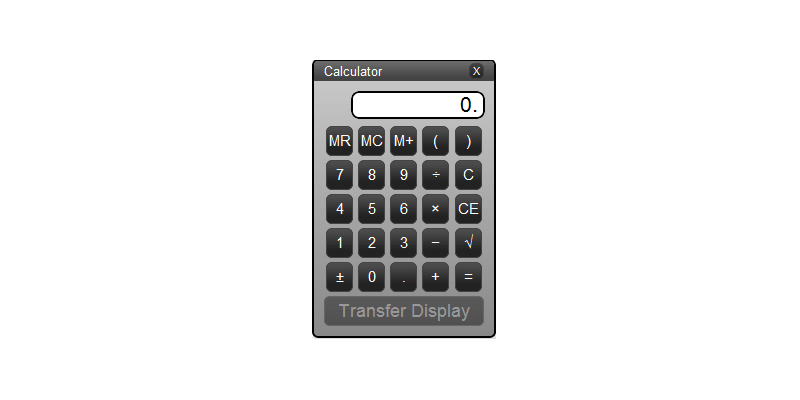
The calculator has its uses, but be sure to practice with it ahead of time so that you’re comfortable using it. Likewise, don’t neglect estimation and quick mental math since those may save you some time. Also, you do get scratch paper to work on during the exam.
GRE Math Assumptions
Most of the math on the GRE follows the basic number conventions that you learned in high school. For example:
- The positive direction of a number line is to the right and the negative direction is to the left.
- Distances are nonnegative.
- Prime numbers are greater than 1.
However, one key thing to call out is that geometric diagrams are not necessarily drawn to scale. A common trap on the test involves assuming that a diagram is a square just because it looks like a square. Thus, make sure other information in the problem confirms (or rules out) that it is indeed a square.
If you’re curious about all the assumptions used on the GRE, see ETS’s Math Conventions PDF for the GRE Quantitative Reasoning Section. This isn’t essential for your prep, but it can give you some insights into how the exam works.
How to Study for GRE Math
So you’ve bought a few of the major GRE prep books, and you’re ready to rip into the quantitative part. You’ll read through each book, page by page, and by the end, GRE math mastery will be yours. If only!
Studying for GRE quant is actually much more complicated than the above. Indeed many become quickly stymied by such an approach, feeling that after hundreds of pages and tens of hours they’ve learned very little, and asking themselves, “How can I ever learn math?”
To avoid such a thing befalling you, keep in mind the following important points on how to study for the GRE Quantitative Reasoning section.
Be Careful Using Formulas
How can formulas be bad, you may ask? Aren’t they the lifeblood of GRE Math? Actually, formulas are only helpful to a point. And they definitely aren’t the lifeblood of the Quantitative Reasoning section. That would be problem-solving skills.
Many students feel that all they have to do is use the formulas and they can solve a question. The reality is you must first decipher what the question is asking. Only at the very end, once you know how the different parts come together, can you “set up” the question for a formula.
All too often many students let the formulas do the thinking. By that I mean they see a word problem—say a distance/rate question, and instead of deconstructing the problem, they instantly come up with distance = rate x time and start plugging in parts of the question. In other words, they expect the question to fall neatly into the formula.
If you find yourself stuck in a problem with only a formula or two in hand, remember that the essence of problem solving is just that: solving the problem using logic, so you can use the formula when appropriate.
Start Slowly with GRE Math, Then Build from There
Many students learn some basic concepts and feel that they have the hang of it. As soon as they are thrown into a random fray of questions, they become discombobulated, uncertain of exactly what problem type they are dealing with.
Basic problems are an excellent way to begin studying. This phase, however, represents the “training wheels.”
Actually riding a bike, much like successfully answering a potpourri of questions, hinges on doing GRE Math practice sessions that take you out of your comfort zone. In other words, you should try a few practice questions chosen at random in your math review. Even if you haven’t seen the concept before, you’ll get a feel for working through a question will limited information.
Oftentimes students balk at this advice, saying, “but I haven’t learned how to X, Y, or Z yet.” The reality is that students can actually solve many problems based on what they already know. However, because the GRE “cloaks” its questions, many familiar concepts are disguised in a welter of verbiage or other such obfuscation.
Study All Concept Areas
Some students become obsessed with a certain question type, at the expense of ignoring equally important concepts. For instance, some students begin to focus only on algebra, forgetting geometry, rates, counting, and many of the other important concepts.
This “tunnel vision” is dangerous; much as the “training wheels” phase lulls you into a false sense of complacency, only doing a certain problem type atrophies the part of your math brain responsible for being able to identify the type of question and the steps necessary to solve it.
Focus on the Most Commonly Tested Areas
This is a subset of “tunnel vision.” Ultimately, it is a more acute case. To illustrate, some students will spend an inordinate amount of time learning permutations and combinations, which might show up once or twice (or not at all!). Study time is always better spent on more heavily-tested content areas, such as number properties and even geometry.
💡 Also, take a look at our advice about how to most effectively study for the GRE in general.
Free GRE Math Prep Resources
Sample Practice Questions
- Sample Every Type of GRE Question (both Math and Verbal)
- 15 GRE Math Practice Questions with Explanations (All question types)
- Quantitative Comparison Practice
- Practice for Problem Solving Question Types
- GRE Math Diagnostic Quiz
- Full-Length GRE Practice Test
Study Schedules
GRE Math Formulas
Frequently Asked Questions
What math is on the GRE?
27 questions in 47 minutes, covering topics from Arithmetic, Algebra, Geometry, and Data Interpretation.
These questions are split over two sections, and you’ll encounter a variety of question types beyond standard multiple choice.
What level is GRE math?
The GRE covers math up to what you likely encountered in either your sophomore and/or junior year of high school, often referred to as an Algebra II class. However, even then, the most advanced math tested on the GRE is only a subset of that. As an example, you probably spent a lot of time graphing functions in high school, but the GRE won’t ask you to do that. The GRE focuses much more on Arithmetic, Algebra I, and Geometry (but no proofs, thankfully!).
Is GRE math harder than SAT math?
GRE math is harder for a few reasons. Its questions often involve multiple layers to unpack, which requires more critical thinking. The SAT, on the other hand, can often be solved more mechanically. Additionally, deciphering what exactly a GRE question is asking tends to be more of a challenge than the more straightforward SAT questions.
With that said, the SAT actually tests more topics (for example, trigonometry and much more of Algebra II). So, there’s less you need to know for the GRE, but that doesn’t necessarily make it any easier.
Learn more about how hard the GRE is in comparison to other exams.
Closing Thoughts
In a nutshell, that’s everything you need to know about how to study for the GRE Quantitative Reasoning section! Keep in mind that you’ll want the strongest GRE Math prep materials possible. We recommend taking a look at a Magoosh GRE Premium plan. As you prepare for the exam, remember to take practice tests, focus on the most commonly tested areas (but study ALL areas), pace yourself, start slow and build from there. This will help get you where you want to be on test day to get the GRE scores you want and get into the graduate schools of your dreams. Good luck and happy studying!