

Understand this common grammatical structure on GMAT SC questions!
Present participles
When we take a verb and stick the “-ing/” ending on it, we change it into the present participle, which can function as a noun modifier, i.e., as an adjective. Examples: the flowing river, the talking horse, the flying trapeze. A participle can take the role of an adjective, but it still can retain its other “verb qualities,” such as taking a direct object. This means, we can create long modifying phrases for nouns called “participial phrases.”
Examples:
1) The man, seeing the fallen tree in the road ahead, ….
2) The student, thinking that time was about to run out on her exam, …
3) The goat, looking at the delicious looking fruit on the other side of the fence, …
In all three of those examples, the underlined phrase is a participial phrase. Notice that none of those three is a complete sentence — all three of them are of the form [noun][noun modifier], so they all need a main verb to make a full independent sentence.
Past participles
Verbs also have past participles: this is the form of the verb that would follow “have” or “had” in, say, the past perfect tense. For ordinary verbs, the past participle is identical to the past tense, and just involves the “-ed” ending, but several common verbs are irregular. For some irregular verbs, the simple past tense forms and the past participle forms do not follow the “-ed” patterns, but are still the same; for other past participle verbs, all three forms (present, past, past participle) are different.
Examples of irregular verbs in which the past and past participle forms are the same:
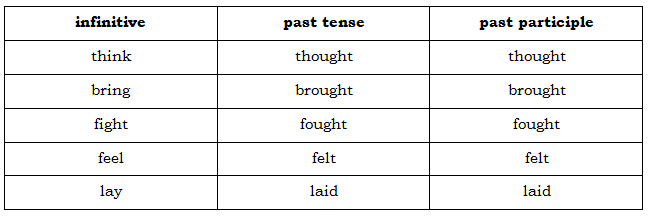
Examples of irregular verbs in which all three forms are different:
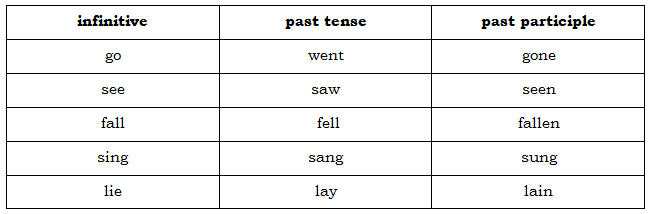
(For more on the lie/lay distinction, see this post.) All of these past participles, in addition to being used in constructions involving the past perfect and other tenses, can also be used to construct participial phrases. Here are some examples of participial phases with past participles.
4) The man, seen on nationwide TV on Super Bowl Sunday, ….
5) The large sum, given to the struggling diabetes research center, ….
6) “God Bless America”, sung during the “seventh-inning stretch” at Yankee Stadium, …
In all three of those examples, the underlined phrase is a participial phrase using the past participle. Again, notice, none of those three is a complete sentence — all three of them are of the form [noun][noun modifier], so they all need a main verb to make a full independent sentence.
What participial phrases can and can’t do
The big idea is: participles and participial phrases are modifiers. They act as an adjective, modifying any noun in the sentence, or they can act as an adverb, modifying one of the main verbs of the sentence. By contrast, a participial phrase cannot usurp the role of the main verb of a sentence or clause. It’s actually a bit ironic that this verb form, a participle, is allowed to act as an adjective or adverb, but not as a verb!
One of the most common mistake patterns on the GMAT Sentence Correction is substituting a participial phrase for the full [noun + verb] requirement of a subordinate clause. This is a particularly tempting mistake, because it is regularly used in colloquial English and thus may sound correct. Here’s an example of the mistake:

By GMAT SC standards, that sentence is 100% wrong. Yes, it may sound correct to your ear: this is one of the instances in which your ear is likely to betray you on the Sentence Correction. The subordinate clause, beginning with the conjunction “although,” needs a full noun + verb clause of its own. Here’s a corrected version of that sentence:
7b) Although Jefferson opposed slavery on philosophical grounds, he owned a plantation with several hundred slaves.
Now, both the subordinate clause and the main clause have their own required noun + verb structure. Again, I cannot caution you enough about this subtle mistake: expect to see it all over the GMAT SC section.
A related mistake, also of the participle-instead-of-verb variety, occurs when a sentence is so long, so complex, that one simply can lose track of what the main subject is and what the main verb is. Consider the following incorrect sentence:
8) After a fire in June 1194 damaged the earlier, smaller church, the Chartres Cathedral, the first church to reach the truly soaring heights that we now associate with high Gothic architecture, built in the first half of thirteenth century, thereafter serving as the example par excellence for Gothic cathedrals throughout Western Europe over the subsequent centuries.
Wow! There’s certainly a ton of information in that sentence, but unfortunately, there’s no verb. The main subject “the Chartres Cathedral” is followed by participle modifiers (“built” and “serving”), but it simply has no verb. This is another classic mistake pattern the GMAT loves: make the sentence so long and complex that folks don’t realize a main verb is missing. To correct this sentence, we would have to take one of those participles, say “built”, and change it to a proper verb form: “was built.”
If you understand both the proper uses of a participial phrase and these two common mistake patterns, you will be able to crack some of the hardest GMAT SC questions.
Practice question
Here’s a practice question that features some participial phrases.








Leave a Reply