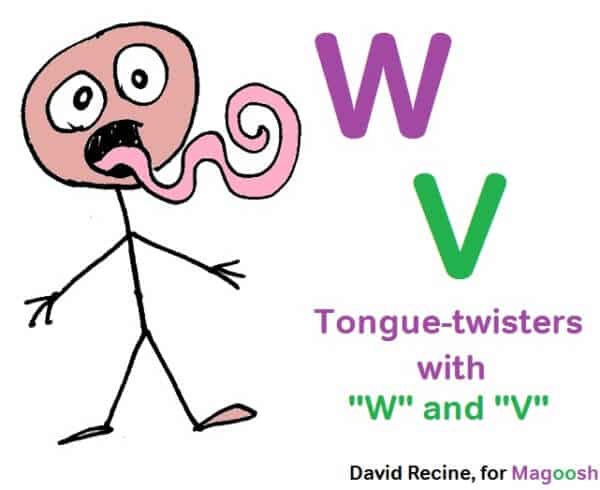
It can be hard to distinguish between the English “W” and “V.” I’ve created some tongue twisters to help you practice these two sounds.
Table of Contents
Noticing the Difference Between “W” and “V”
First of all, note that for the “W” sound in English, you do not use your teeth at all. Instead, you pull your lips into a tiny circle, similar to the lip formation you’d use to make the “oo” vowel sound in words like “pool” or “moon.” It’s the English “V” where you do use your teeth. To make the “V” sound in English, you place your upper teeth lightly on the inside of your lower lip and gently blow out air, while using your vocal cords.
It may help to see what these lip formations actually look like, so be sure to check out the Magoosh Comic illustrating the “W” and “V” mouth movements. It may also help to hear what the combined lip and vocal cord movements sound like for each of these sounds. Listen below:
Me, saying “wwwwwwwwwwwwuh:”
Me, saying “vvvvvvvvvvvvvvvvvuh:”
Pro tip: To feel the difference in your own mouth, try this: hold your fingers lightly against your throat and say “wwwwuh,” then “vvvvuh.” You’ll feel vibration for both—but notice that for “W” your lips are rounded and your teeth never touch, while for “V” your upper teeth rest on your lower lip.
Minimal Pairs with “W” and “V”
Now that you’ve heard these sounds in clear contrast, let’s practice some tongue twisters that consist entirely of minimal pairs. Minimal pairs are pairs of words that sound almost exactly the same, usually with just one sound difference. These kinds of word pairs are very useful for both pronunciation and listening skills in English.
I’ve included an audio file with each minimal pair so that you can hear the correct pronunciation before trying it yourself. In each audio file, I’ll say the pair slowly one time, and then one time at a normal pace. Practice your pronunciation by repeating after me.
went, vent:
win, VIN:
Wally, volley:
wick, Vick:
will, ville:
worst, versed:
Full-Length Tongue Twisters
Once you’ve gotten the hang of these, you’re ready for a couple of longer tongue twisters. Again, I’ve included sound files so that you can listen to a native English speaker’s pronunciation before you practice on your own. I speak fairly slowly in the audio. But to challenge yourself and build your pronunciation skills, try to see how quickly you can say these with correct pronunciation.
W/V tongue twister #1: She had vicious wishes that the worst would happen to the versed men; these vicious wishes made the versed men very wary that the worst could happen.
W/V tongue twister #2: We went to Wally’s volleyball event under the village’s wilted willow, with victory in mind. Wally would win the volley versus Vinny.
Pro tip: Don’t just listen and move on—record yourself saying the tongue twisters and compare your recording to the audio. It’s one of the fastest ways to catch mistakes you can’t hear in real time.
Looking for More Help?
You can practice the TOEFL Speaking section under test-like conditions in our free TOEFL practice test. Take a complete TOEFL practice exam or just practice a mock Speaking section based on your goals. Looking for more? You can get a free trial of Magoosh TOEFL Prep today—it has helped countless TOEFL students over the years with best-in-class practice questions and explanations. Let us help you surpass your score goals and get into the program of your dreams!