
offers hundreds of GRE video lessons and practice questions. Go there now.
Sign up or log in to Magoosh GRE Prep.

Normal Distribution on the GRE

A distribution is a graph that shows what values of variable are more or less common in a population. Where the graph is higher, there are more people, and where the graph has a height close to zero, there are fewer people.


By far, the most famous and most useful distribution is the Normal Distribution, a.k.a the “bell curve.”  It shows up everywhere, with an almost eerie universality.  Suppose you were to measure one genetically determined bodily measurement (e.g. thumb length, distance between pupils, etc.) for every single human being on the planet, and then graphed the distribution: it would be a normal distribution.  Same, for any genetically determined bodily measurement you could make on an animal or a plant, and measured it for every member of that species, it would be a normal distribution.  The normal distribution is the shape of the distribution of any naturally occurring variable of any natural population.  (Something like blood pressure might not be as normally distributed, because there are cultural and social factors that impinge on blood pressure – it’s not purely natural, unadulterated by culture.)


Properties of the Normal Distribution

All normal distributions on earth, from giraffe height to ant height, share certain fundamental properties in common.

It’s important to appreciate that any Normal Distribution comes with its own “yardstick”, and that yardstick is the standard deviation.  You can read more about standard deviation here.  The very center of the Normal Distribution is the mean and median and mode all in one.  We use the standard deviation to measure distances from the mean.  If we go out a length of one standard deviation from the mean on either side,
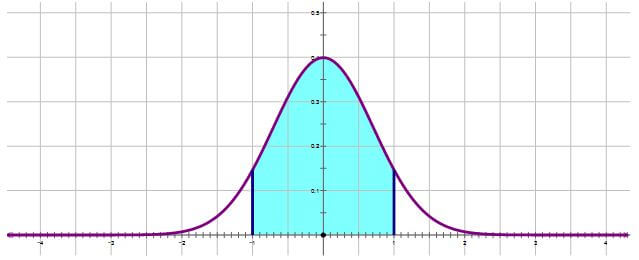
 

that always includes 68% of the population, a little over two-thirds. This means that on either side, there is 34% of the population, very close to one-third: there’s 34% below the mean and one standard deviation above the mean, and there’s another 34% below the mean and one standard deviation above the mean.

If we go two standard deviations from the mean in either direction,
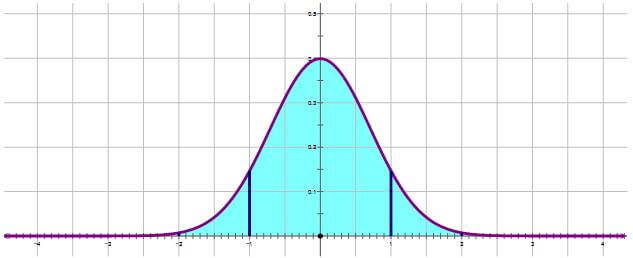


that always includes 95% of the population.  You are somewhat uncommon if you are more than two standard deviations from the mean.

If we go out to three standard deviations from the mean in either direction, that includes 99.7% of the population, with only 0.15% (i.e. 15 people out of 10000) falling in each tail beyond this.  The folks who are more than three standard deviation above the mean: they are the true outliers — the major league baseball hitters, the world famous violinists, the brilliant scientists and researchers — they truly stand out from the population at large.

If you simply remember these two numbers:

  • 68% within one standard deviation of the mean (which means, 34% on each side)
  • 95% within two standard deviations of the mean

then will have the ability figure out any GRE Math question that address the Normal Distribution.


About the Author

Mike McGarry is a Content Developer for Magoosh with over 20 years of teaching experience. He enjoys hitting foosballs into orbit, and despite having no obvious cranial deficiency, he insists on rooting for the NY Mets.

31 Responses to Normal Distribution on the GRE

  1. Sid August 12, 2012 at 12:23 pm #

    I shall keep the visualization bit in mind, I do have a question, it is from the OG (1e), page 331, Q9

    A random variable Y is normally distributed with a mean of 200 and a standard deviation of 10

    Column A: The probability of the event that the value of Y is greater than 220
    Column B: 1/6

    The solution says there is a chance of under 5% it would be greater 220,

    From whatever I have come to understand of S.D. (all of it through this post and the one by Chris) I just wished to confirm, it is a 2.5% chance to be over 220, isn’t it?

    Thanking You,
    Sid

    • Sid August 12, 2012 at 2:12 pm #

      wished to confirm the exact value*

    • Mike August 12, 2012 at 10:06 pm #

      Sid: Yes, precisely — the probability of being more than 2 S.D above the mean (or more than 2 S.D. below the mean) is 2.5%.
      Mike :-)

      • Sid August 13, 2012 at 3:26 am #

        thank you so much, Mike, Standard Deviation is finally not as daunting :)

        Regards
        Sid

        • Mike August 13, 2012 at 9:52 am #

          You are quite welcome. I’m glad my words were helpful.
          Mike :-)

  2. Praveen July 28, 2012 at 9:56 pm #

    Hi,

    Can you suggest an alternate approach to the problem 5 from “ETS official guide to GRE Revised”, set3 discreet questions :Hard quantitative comparison.I am unable to spot a similar problem in our practice sets.

    It goes like the random variable x is normally distributed and values 650 and 850 are 60th and 90th percentiles of distribution.

    quantity a: the value at the 75th percentile of distribution of x
    quantity b: 750

    Thanks,
    praveen

    • Mike July 30, 2012 at 10:07 am #

      Praveen: First of all, when you ask a question from the OG, please give the *page number*. This problem is p. 156 in both the OG(1e) & the OG(2e).
      We know 650 is the 60th percentile — it is just above the center hump of the Bell Curve (center hump = mean = median = mode = 50th percentile). 850 is the 90th percentile, way out on the arm of the Bell Curve. The height of the Bell Curve declines precipitously as we walk from X = 650 to X = 850. Suppose we walk halfway, out to X = 750 — the question is: of the slice of Bell Curve between 650 and 850, between the 60th percentile and the 90th percentile, is more than half before or after X = 750. Well, the curve is declining precipitously in this region, so the height of the curve is *much higher* before X = 750 than after X = 750. Another way to say it is: the Bell Curve is densest toward its center. Again, considering the slice between 650 and 850, more than half will be toward the center, to the left of X = 750. Therefore, the halfway percentile, the 75th percentile, has to be to the left of X = 750, in other words, has to have an X-value that’s less than 750. Answer = A.
      The question is a deep *visualization* question.
      Does all that make sense? Please let me know if you have any further questions.
      Mike :-)

      • Praveen July 30, 2012 at 9:12 pm #

        Makes perfect sense.

        Thank you so much Mike :)

        • Mike July 31, 2012 at 5:34 pm #

          You are quite welcome. Best of luck to you.
          Mike :-)

          • Sid August 10, 2012 at 4:42 am #

            thank you for the explanation, this was indeed a confusing problem, and I can only hope they do not surface often on the test

            A small typo there, however, the correct choice is B

            • Mike August 10, 2012 at 11:17 am #

              Sid:
              Well, this question is in the OG, so it’s fair game for the GRE. This question is specific to the Normal Distribution, but *visualization* is a powerful strategy that can help you throughout the Quant section.
              Mike :-)

  3. praneeth103 July 14, 2012 at 11:43 am #

    Sir
    regarding normal distributions is it enough to just know the 2 percentages (68,95) and its behaviour on deviating by 2 standard deviations either side?

    • Mike July 15, 2012 at 9:41 am #

      Praneeth: Yes, those are the only two numbers you need to know from memory. I will say, though, the GRE might expect you to *do* things with those numbers. For example, what percent of the population is *between* the mean and 1 S.D. above the mean? That’s 68/2 = 34%. How much of the population is above a score 1 S.D. below the mean? Well, that’s the 34% from that place up to the mean, and then the whole 50% above the mean, so that’s 84%. Do you see what I mean? The only numbers you have to have memorized are the 68 and the 95, but you could be expected to divide those in half and add or subtract pieces to get specified regions under the Bell Curve. Does all that make sense?
      Mike :-)

      • Karthik July 16, 2012 at 8:27 am #

        Excellent explanation of the concepts. Thanks!!

        • Mike July 16, 2012 at 5:24 pm #

          Thanks for the compliments. Best of luck to you.
          Mike :-)

  4. neha July 10, 2012 at 1:34 pm #

    Thanks a lot for quick response.
    Yes, the question is from a GRE prep source. But now, as you have said I won’t go in that much detail.
    Thanks!

    • Mike July 10, 2012 at 8:53 pm #

      You are quite welcome. Best of luck to you!
      Mike :-)

  5. neha July 9, 2012 at 11:34 am #

    hiii..
    I was trying to solve this question :
    The scores of an IQ test are normally distributed. The mean is 81 and standard deviation is 6.3. The probability that a person who takes the test will score between 68.4 and 87.3 will be _________% (round off to one digit after the decimal point)….

    I just calculated that 87.3 is at 1 unit of sd from mean and 68.4 is 2 units of SD below mean
    => 34% + 34% + 14% = 82%

    but the answer is 81.8%…. values taken are 34.1 and 13.6
    I am confused which values to take for solving the question. Please clarify.

    • Mike July 9, 2012 at 6:58 pm #

      Neha: Is that question from a GRE prep source? So far as I know, the GRE does not expect you to do normal distribution calculations so precise that you will have to distinguish between 82% and 81.8% —- yes, on a GRE question, 81.8% might be listed as the answer, but estimating 82% would be enough to get that answer. Whatever source is advocating knowing normal distribution values to the tenth’s place is simply going over the top. That’s flamboyantly unnecessary. Stick with the values given in this post.
      Mike :-)

  6. Hicham June 27, 2012 at 3:22 am #

    Shouldn’t the percentage within two standard deviations from the mean be 96% instead of 95% ?

    • Mike June 27, 2012 at 9:09 am #

      Dear Hicham: Technically, it’s 95.44998759715%, so that’s closer to 95%. Also, 95% is a nice round number to remember.
      Mike :-)

  7. Shubham June 20, 2012 at 7:37 pm #

    Great Stuff. Thanks Sir!

    • Mike June 21, 2012 at 8:58 am #

      Thank you. Best of luck to you, sir.
      Mike :)

  8. ALI SOHAIL June 16, 2012 at 4:48 am #

    i want to ask if normal distribution and standard deviations are little different? i saw in books a graph related to prpbabilities distribution..what is that? is that normal distribution?

    • Mike June 18, 2012 at 11:13 am #

      Ali: Excellent question. The Normal Distribution is a *shape*, and the standard deviation is a *number.* The Normal Distribution is a shape, a curve, that shows at what values of the variable you will find the most people. Any particular Normal Distribution is a curve with it’s own particular center (the mean) and it’s own particular spread, or width. For example, adult elephant mass has a higher mean & higher spread than adult ant mass. The standard deviation is a measure of a spread, a measure of how far the individual data points are from the mean, on average. For example, the income distribution among folks with similar job descriptions in the same company would likely have a small standard deviation — those numbers would all be relatively close together. Income distribution of everyone in a major city — business people, homeless, everyone — that would have a HUGE standard deviation, because the numbers on the list deviated so wildly from one another. You can calculate the standard deviation to find the spread of any distribution, but the standard deviation is designed to work best with the Normal Distribution — the standard deviation of an particular Normal Distribution is, as it were, the built-in yardstick that comes with that distribution. You can calculate the standard deviation of other distributions (t-distributions, F-distributions, chi-squared, etc.) but that’s getting into advanced statistics, realms far beyond what you need for the GRE. Does all this make sense? Please let us know if you have any further questions.
      Mike :-)

  9. seaar May 29, 2012 at 2:38 pm #

    You are great.
    thanks

    • Mike May 29, 2012 at 4:21 pm #

      Thank you.
      Mike :)

  10. abhay May 23, 2012 at 9:34 am #

    Very Useful article

    • Mike May 23, 2012 at 2:01 pm #

      Thank you. You are quite welcome. Best of luck to you.
      Mike :)

  11. John January 5, 2012 at 1:19 am #

    Hello,

    Should one of the sentence parts read “below the mean”? or I am I misreading it.

    “there’s 34% between the mean and one standard deviation above the mean, and there’s another 34% between the mean and one standard deviation above the mean.”

    • mikemcgarry January 5, 2012 at 11:56 am #

      Yes, that is a mistake! Great catch. We’ll fix that. Thanks for pointing it out. :-)


Magoosh blog comment policy: To create the best experience for our readers, we will approve and respond to comments that are relevant to the article, general enough to be helpful to other students, concise, and written with correct grammar and spelling! :) If your comment was not approved, it likely did not adhere to these guidelines. If you are a Premium Magoosh customer and would like more personalized service, you can send us any questions you have through the Help tab in the product and we will always respond within 24 hours. Thanks!

Leave a Reply