
Here at Magoosh, our GRE experts spend a lot of time evaluating the quality of GRE prep books. Today, we’re happy to announce that we’ve updated our Best GRE Books List! Read on for honest reviews of what’s out there as well as recommendations for the material(s) best suited to help you master the GRE techniques and strategies necessary to achieve your goal score.
How Do the 2023 Changes to the GRE Affect the Quality of Older Prep Materials?
In short, not at all! Yes, ETS launched a shorter GRE in 2023. However, making the exam shorter was the most significant change. ETS reduced the total number of verbal and quantitative questions and cut one of the two required essays (bye bye, Argument Essay). Because there were no changes to the content that ETS tests, there have been no real changes to the Best Prep Books that cover that content. In fact, at the time of this writing, ETS hasn’t even released a new edition of its own prep material, The Official Guide, but does provide the following note:
“The practice tests in this book are for the General Test that was administered before September 22, 2023. However, because the shorter GRE includes the same question types (except for the Analyze an Argument essay task which has been removed), this book is a great way to prepare for the shorter GRE.”
So, with that in mind, don’t fret if some of the books in this list aren’t the most current. Just be aware that some of the information about the exam’s timing and structure might be inaccurate. Now that you know it’s totally fine to use prep materials that were published before the launch of the shorter GRE, you might also enjoy this bonus: Older materials tend to be a bit cheaper 😀
Click the titles in the table below to jump to my full book review!
| Rank | Title | Publisher | Price |
|---|---|---|---|
| 1 | Magoosh GRE Book | Magoosh | $9.99 (Kindle or free with Kindle Unlimited) $16.99 (Paperback) |
| 2 | The Official Guide to the GRE Revised General Test, 3rd Edition | ETS | $21.99 (Kindle) $32.00 (Paperback on Amazon) $40.00 (Paperback from ETS) |
| 3 | Official GRE Verbal Reasoning Practice Questions & Official GRE Quantitative Reasoning Practice Questions | ETS | Bundled: $17.98 (Kindle) $29.87 (Paperback on Amazon) $37.00 (ebook from ETS) |
| 4 | Official GRE Super Power Pack, 2nd Edition | ETS | $32.26 (Kindle) $33.96 (Paperback on Amazon) $ 72.00 (ebook from ETS) |
| 5 | PowerPrep and PowerPrep PLUS | ETS | FREE (PowerPrep) $39.95 per test (PowerPrep PLUS) |
| 6 | Barron’s 6 GRE Practice Tests | Barron’s | $16.95 (Paperback) |
| 7 | All the GRE: Effective Strategies & Practice, 6th Edition(bundle) | Manhattan | Bundle: $57.12 (Paperback on Amazon) |
| 8 | GRE Prep Plus 2024: 6 Practice Tests + Proven Strategies | Kaplan | $25.00 (Paperback on Amazon) |
| 9 | Magoosh’s Free GRE PDFs | Magoosh | FREE! |
| *HM | 5 lb. Book of GRE Practice Problems, 4th Edition | Manhattan | $24.99 (Kindle) $24.00 (Paperback on Amazon) |
| *HM | GRE Prep, 2024 Edition | The Princeton Review | $22.30 (Regular) $27.80 (Premium) $12.99 (Kindle-Regular and Premium) |
*HM = Honorable Mention
Best GRE Prep Books of 2024-2025: Book Reviews
A couple of notes before we continue:
- Under most reviews, clicking on each book cover will take you to Amazon.com, which generally has the lowest prices. Please note that the prices listed are subject to change. The particular prices given here are in US dollars and reflect the price of a new edition (unless otherwise noted). You can almost always buy a used version at a discount.
- Some of the books listed here are not the newest editions. Most publishers change very little content from one edition to the other. If I can save you money by recommending an old edition of a great book, then I’m going to do that!
Time for the good stuff!
1. Magoosh GRE Book
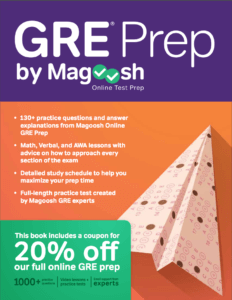
It’s everything you love about Magoosh’s GRE product, in paperback form! Our GRE students and experts have collaborated to produce the most cohesive GRE guide of all time.
This 468-page book packs more than a hundred practice questions accompanied by comprehensive explanations—all pulled directly from our renowned online GRE prep product. Not only is the book loaded with tons of useful information, but each question and answer has been triple checked by industry experts to maximize students’ learning. If you’re in the market for a GRE book, we hope you’ll take a look at GRE Prep by Magoosh!
This can be used as a standalone book or in combination with Magoosh’s GRE prep course for even more practice!
2. ETS’s The Official Guide to the GRE Revised General Test, 3rd Edition
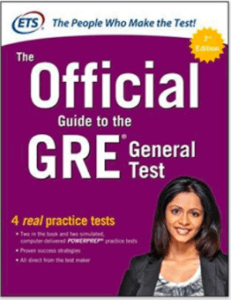
This is the holy grail of prep. If you can only buy one book, this is it. The tone of voice may not be as friendly as the other books on the market. But if you can bear the dry content, you are getting by far the best practice since the material is written by the folks who write the exam.
Throw in four GRE practice tests, and the best GRE book on the market gets even better.
3. ETS’s Official GRE Verbal Reasoning Practice Questions & Official GRE Quantitative Reasoning Practice Questions
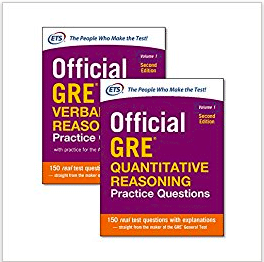
This one’s a twofer.The Verbal book contains tons of official GRE verbal reasoning questions, written by the makers of the GRE. The strategies are nothing new, but this book is a must-buy, if only for the quality of its practice questions. The Quantitative Reasoning book, on the other hand, contains both helpful practice problems and useful new strategies for quantitative reasoning questions. A word of warning: the math problems in this book can be really challenging. They’ll definitely require some extra attention, but will help you up your quant game.
4. Official GRE Super Power Prep, 2nd Edition
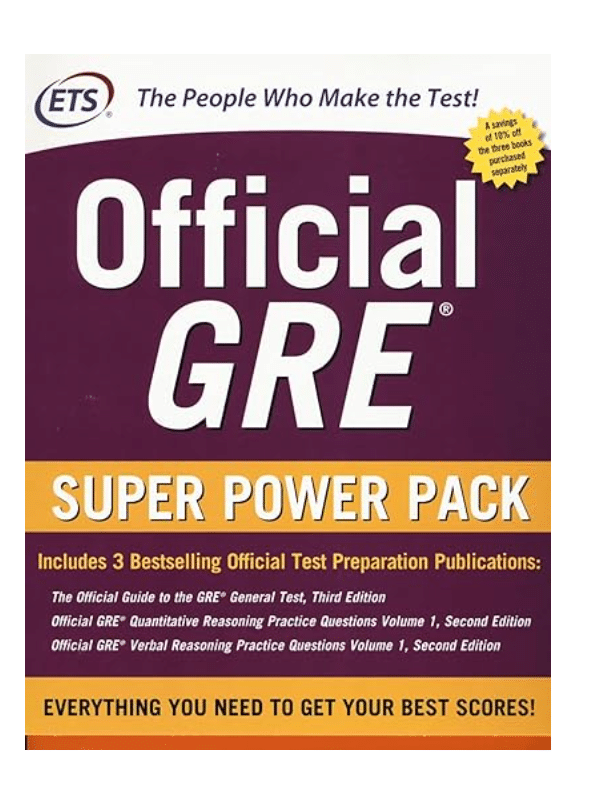
This offering from ETS bundles the three official guides we’ve just discussed. So, if you are sure you want The Official Guide, 3rd Edition, The Official GRE Verbal Reasoning Practice Questions, and The Official GRE Quantitative Reasoning Practice Questions then this Super Power Prep offering is a cost-savings option for you to consider.
5. PowerPrep and PowerPrep PLUS

By this point, you’ve probably noticed that ETS has a lot of products to help you prepare for the GRE. And they’re all excellent.
This is great news if you have a lot of time and money to spend before the test! Of course, if you don’t, it starts to get a little confusing (and to make it more confusing, ETS has repurposed some old tests! For all the info on this, check out Magoosh’s PowerPrep article).
Let’s clarify a couple things. First, there are two PowerPreps: the free version (just “PowerPrep”) and the paid versions (“PowerPrep PLUS,” two tests that cost $39.95 each).
No matter what, it’s a good idea to take at least one, and preferably both, of the free PowerPrep tests before your official exam. You’ll get to work with the computer format, and you’ll see questions straight from the test-makers.
If you have time, the PowerPrep PLUS tests do provide great practice—the explanations are a little brief, though it can be good practice to work out the processes on your own—but at a price. If you buy both of these exams, you’re basically paying half of what it costs to take the official GRE.
At the end of the day, it can be tricky to find great GRE practice tests, so if you’re preparing over a long period of time, buying at least one PowerPrep PLUS test is a good idea. But if you have a month or less before test day? You probably don’t need to make the investment.
6. Barron’s 6 GRE Practice Tests
This book is not perfect, even in its third edition, but in terms of sheer content, it is better than the Barron’s general GRE guide. Bottom line: the questions are solid, but the difficulty is a little off (the questions are on average a little less tricky than the real thing), so it’s better to use this book as a question bank for extra practice, rather than as a source of balanced practice tests.
7. Manhattan All the GRE Math and Verbal set
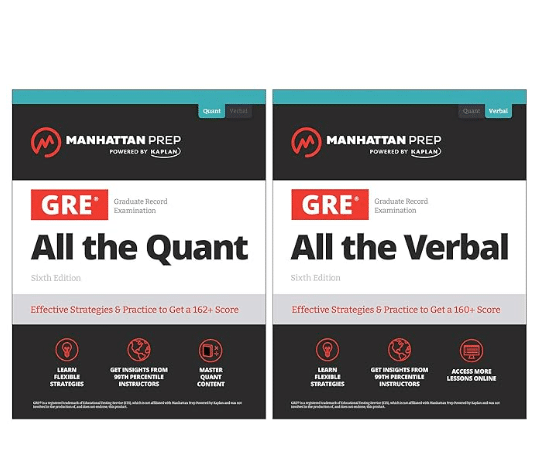
This is Manhattan’s updated version of its GRE Math & Verbal Strategies Set. Manhattan Prep materials are our most recommended after those from ETS and our own, and these books live up to the reputation. The question quality is high, and while the explanations are on the lighter side (similar to other Manhattan products), the books are still a good value.
Diving into the specifics, the math is solid. The lesson sections are perfect for students who have some hazy memory of the topics and need explanations and examples, but they would not be sufficient for students who need to learn from scratch. Verbal is similar. The question difficulty range is solid, and the explanations are a little light.
8. Kaplan’s GRE Prep Plus 2024-2025
Many of you will be familiar with Kaplan’s ACT and SAT courses. These courses can be of uneven quality. But Kaplan’s GRE Prep Plus 2024 is pretty solid, so throw away your preconceptions.
In terms of content, the Verbal section provides excellent exam and content strategies and includes high quality, medium to difficult practice questions. These aren’t as good as some of the others on this list, but they can help you to introduce GRE-style questions. Another advantage is that it doesn’t focus too much on memorizing the GRE vocabulary. Instead, it helps you primarily with vocabulary acquisition strategies. In Math, if you’ve seen the concepts before, the content review is solid, and practicing with this book can give you good experience with different levels of difficulty.
9. Free GRE PDFs
Okay, they are not really books since unless you print them, you can’t physically hold them and flip through the pages (though an iPad or a Kindle can add a high degree of verisimilitude to the experience). Tangible or not, these PDFs are free and they provide a wealth of helpful strategies. Along with the rest of Magoosh’s free GRE resources, they are a great way to start your GRE journey, before deciding on which book to purchase. Download them from this page: Magoosh GRE PDFs.
GRE Book Honorable Mentions
1. Manhattan 5 lb. Book of GRE Practice Problems
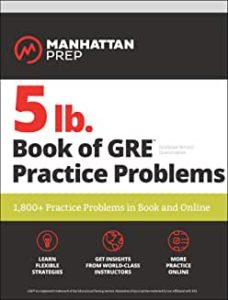
This book is actually quite good in many respects. So why does this very large collection of Manhattan GRE practice problems only get honorable mention?
The truth is that this book’s Verbal practice problems have a number of problems. Unfortunately, the Verbal questions for Manhattan GRE are weak and not as GRE-like as they should be. Some light Verbal practice from this book may help you get familiar with the basic question types and formats. However, relying heavily on this book for Verbal practice will leave you ill-prepared for the real exam. ETS’s actual GRE Verbal problems are different from the ones in the Manhattan 5 lb. Book, in countless subtle-but-important ways.
Math, on the other hand, is where this book really shines. The Math problems are spot-on to the real test. All the math questions are very well designed, aptly capturing the tone, look, feel, and range of the real GRE Math section. The answer explanations are a little light, but sufficient. Given that the Quant half of this book is solid, think of the Manhattan 5 lb. Book as a Manhattan 2.5 lb. book for the purposes of your GRE prep.
2. The Princeton Review, GRE Prep, 36th Edition
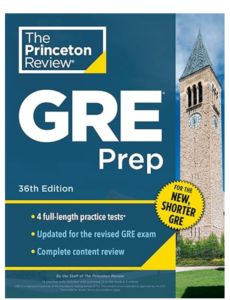
I somewhat like the Princeton Review books for their big-picture strategies. These strategies are mostly absent from the Official Guide. The content is a little generic and could apply to most standardized tests rather than the GRE specifically. However, if you are feeling lost with test prep in general and could use some review of basic skills like interpreting questions and using process of elimination, this could be a helpful resource. There are many different editions of Princeton Review books with slightly different amounts of content and prices, which gives you some flexibility about which one to go for.
Note: There is also a “premium” version of this book has additional practice tests.
What makes a good GRE prep book?
What makes a good GRE prep book may seem subjective, but there are actually some pretty solid criteria we can use to rate each one with relative objectively. Here’s how we evaluated the GRE study guides out there!
- Depth and quality of review material: Good test prep books will have in-depth overviews of the material you need to know for the GRE general test. This includes both content areas (e.g. number properties, statistics) and question formats (e.g. sentence equivalence, reading comprehension, word problems). However, longer isn’t always better: you want a book that will cover the material you’ll see on the GRE—and only that material! Extraneous explanations won’t help and could overwhelm you, making prepping for the GRE all the harder.
- Quality of practice GRE problems: Trust us, you don’t get to be a master of quantitative comparisons, text completion questions, sentence equivalences or…well, any part of the GRE unless you’ve worked with test-like materials. This means that the questions should mimic what you’ll see on test day, be formatted using GRE standards, and be of a similar difficulty level to the official exam.
- Clarity and thoroughness of explanations: You could be working with the best-written GRE questions in the world and it wouldn’t matter if you don’t understand exactly why each correct answer is correct. As a general rule of thumb, longer, more detailed answer explanations are better—with the caveat that they should also be really clear. Ideally, they’d break down why each incorrect answer choice is wrong, as well as why the correct answer is right.
- Number and quality of practice tests: It’s really hard to show up to the GRE exam and do well if you haven’t had practice taking lots of high-quality practice tests. Great GRE test prep books will give you at least one, and preferably more, tests with thorough answers and in-depth explanations.
More Books and Resources for GRE Prep
You don’t need to spend hundreds of dollars on the best GRE prep books to get a great score on the GRE. Magoosh has a ton of great resources available on the blog for free. For a diagnostic quiz, try one or both of the following:
And when you are ready to dive-in and commit to prepping for the GRE, one of the first steps with be to take a full-length practice test. Doing so will help you get a sense of your strengths and weaknesses and how far your current score is from your goal score. Check out Magoosh’s GRE practice test!
Best of luck and happy studying!