
The ACT Math Test loves triangles. Out of all the ACT math topics tested, the triangle is the most commonly tested geometric shape. And among triangles, the right triangle shows up the most.
The good news: you only need two tools to handle almost every right triangle question. The first is the Pythagorean theorem. The second is the set of special right triangle ratios (the 30-60-90 and the 45-45-90). Learn these two things well, and right triangles turn into some of the fastest points on the test.
Quick currency note: This advice reflects the current Enhanced ACT. The Math section now has 45 questions in 50 minutes, each with four answer choices (the older format had five). A calculator is allowed on Math. The math content tested has not changed, so everything below still applies exactly as it did before.
Table of Contents
The Pythagorean Theorem
The Pythagorean theorem is a formula used to find the third side of a right triangle when you know the other two sides. It looks like this:

In this formula, a and b are the two shorter sides (the legs), and c is the hypotenuse, the name given to the side across from the 90-degree angle. The hypotenuse is always the longest side.
That’s the whole formula. Square the two legs, add them, and the result equals the square of the hypotenuse.
Is the Pythagorean Theorem Only for Right Triangles?
Yes. The Pythagorean theorem only works for right triangles, meaning triangles that contain a 90-degree angle.
Here is why. The relationship a² + b² = c² is true only when the angle between sides a and b is exactly 90 degrees. If that angle is smaller, the third side comes up shorter than the formula predicts. If the angle is larger, the third side comes up longer. The clean a² + b² = c² balance holds at 90 degrees and nowhere else.
So before you reach for the theorem, confirm the triangle has a right angle. The ACT usually tells you, either by labeling a 90-degree angle, by drawing the little square in the corner, or by using the word “right.” If there’s no right angle, the Pythagorean theorem does not apply, and you’ll need a different approach.
Pro tip: A common ACT trap is a problem that looks like it wants the Pythagorean theorem but never actually states a right angle. Always check for the right angle first. No right angle means no Pythagorean theorem.
Common Pythagorean Triples
To save time on the ACT Math Test, it helps to memorize and recognize the common Pythagorean triples. These are sets of whole-number side lengths that satisfy the Pythagorean theorem and come up again and again in right triangles. When you spot one, you can write down the missing side instantly instead of doing the arithmetic.
The two most common are 3:4:5 and 5:12:13. These ratios also hold for any multiple of those numbers, so a triangle with sides 6:8:10 is just a 3:4:5 doubled, and 10:24:26 is 5:12:13 doubled.
Here are the triples worth memorizing for the ACT:
| Pythagorean triple | Check (a² + b² = c²) | Common multiples you’ll also see |
|---|---|---|
| 3 : 4 : 5 | 9 + 16 = 25 | 6:8:10, 9:12:15, 12:16:20 |
| 5 : 12 : 13 | 25 + 144 = 169 | 10:24:26, 15:36:39 |
| 8 : 15 : 17 | 64 + 225 = 289 | 16:30:34 |
| 7 : 24 : 25 | 49 + 576 = 625 | 14:48:50 |
How to use them: if you are told a right triangle has a hypotenuse of 10 and one leg of 6, you can tell the third side is 8 without any calculation. The sides fit a 6 : x : 10 ratio, and if you divide everything by two, that becomes 3 : (x/2) : 5. That looks exactly like 3:4:5, so x/2 = 4, which means x = 8. Definitely a good time-saver.
Pro tip: When a right triangle problem gives you two “ugly” numbers, check whether they match a triple (or a multiple of one) before grinding through the algebra. Recognizing 3:4:5 hidden inside 9:12:15 can save you 30 seconds.
Special Right Triangles: 30-60-90 and 45-45-90
There are two right triangles so important that they get their own name: the special right triangles. They are special because the ratio of their sides never changes, no matter how big or small the triangle is. If you know one side, you know all three.
The first is the 30-60-90 triangle. Its sides are always in the ratio x : x√3 : 2x, where x is the side opposite the 30-degree angle.
The second is the 45-45-90 triangle. Its sides are always in the ratio x : x : x√2, where the two legs are equal and x√2 is the hypotenuse.

Here are the two ratios side by side so you can keep them straight:
| Triangle | Angles | Side ratio | Which side is which |
|---|---|---|---|
| 45-45-90 | 45°, 45°, 90° | x : x : x√2 | The two legs are equal (x); the hypotenuse is x√2 |
| 30-60-90 | 30°, 60°, 90° | x : x√3 : 2x | x is opposite 30°; x√3 is opposite 60°; 2x (the hypotenuse) is opposite 90° |
It’s important to remember that for the 30-60-90 triangle, the hypotenuse is the side with the ratio of 2x. Don’t confuse it with the 45-45-90 ratio and assume the x√3 belongs in the hypotenuse spot. The longest side is always opposite the 90-degree angle.
Pro tip: A classic ACT trap mixes up these ratios. Watch for answer choices that swap x√3 and 2x, or that write x + √3 instead of x√3. Read the ratio carefully and match each side to its angle.
Working Without a Calculator
A calculator is allowed on ACT Math, but special right triangles often go faster if you keep the answer in exact form (with the √3 or √2 left in) and match it to the choices. The ACT frequently writes answers as exact radicals, so you may never need to convert at all.
When you do want a quick numeric estimate, memorize these two approximations:
- √2 ≈ 1.41
- √3 ≈ 1.73
So a 45-45-90 triangle with legs of 5 has a hypotenuse of 5√2 ≈ 7.07. A 30-60-90 with a short leg of 4 has a longer leg of 4√3 ≈ 6.93 and a hypotenuse of 8. Estimating like this is a fast way to eliminate answer choices that are clearly too big or too small, even when you can’t fully solve.
A Worked Example
Here’s a question that shows how knowing these special right triangle ratios can be invaluable:
Which of the following sets of three numbers could be the side lengths, in yards, of a right triangle containing a 45° angle?
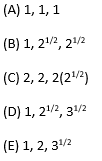
Even if you forgot the 45-45-90 ratios, you can eliminate any choice that doesn’t satisfy the Pythagorean theorem, since the question tells us we’re dealing with a right triangle.
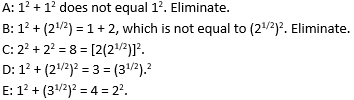
To choose among the remaining options, notice that a right triangle with one 45-degree angle must have a second 45-degree angle, because 180 − 90 − 45 = 45. That means the triangle is isosceles, so the correct answer must contain two equal values. The set with two equal legs is the right one.
Pro tip: On the Enhanced ACT, every Math question has four answer choices. The elimination strategy here works the same regardless of how many choices you see: rule out anything that breaks the Pythagorean theorem, then use the 45-45-90 rule that the two legs must be equal.
Practice and Next Steps
Right triangles reward recognition. Once the Pythagorean theorem, the common triples, and the two special-triangle ratios are automatic, you’ll spot the shortcut before you even finish reading the problem.
When you’re ready to test yourself, work through a set of mixed right triangle problems and time yourself at roughly one minute each, the real ACT Math pace. If you want a baseline for how you’re doing on Math as a whole, a free ACT practice test is a low-pressure way to see where right triangles fit into your overall score. And once you have a target score in mind, our ACT score calculator shows how many questions you need to get right to hit it.
For more practice and step-by-step video explanations of every concept above, Magoosh ACT prep walks you through right triangles and the rest of ACT Math at your own pace.