
offers hundreds of GMAT video lessons and practice questions. Go there now.
Sign up or log in to Magoosh GMAT.

GMAT Quant: Difference of Two Squares

You may remember this formula, one of the sleekest factoring tricks in all of algebra:

y^2 - x^2 = (y + x)(y - x)

This formula, called “the difference of two squares” formula, is a favorite of standardized test writers.  A simple enough pattern: see if you can detect where it shows up in the following challenging problems.


1)  1/{2-sqrt{3}}=

(A) 2 - sqrt{3}

(B) 2 + sqrt{3} 

(C) 1/7

(D) 1/2 - 1/{sqrt{3}}

(E) 1/2 + 1/sqrt{3}


2) What is the sum of a and b?

(1)a = 4

(2){b^2 - a^2}/{ b - a}   = 7

  1. Statement 1 alone is sufficient but statement 2 alone is not sufficient to answer the question asked.
  2. Statement 2 alone is sufficient but statement 1 alone is not sufficient to answer the question asked.
  3. Both statements 1 and 2 together are sufficient to answer the question but neither statement is sufficient alone.
  4. Each statement alone is sufficient to answer the question.
  5. Statements 1 and 2 are not sufficient to answer the question asked and additional data is needed to answer the statements.
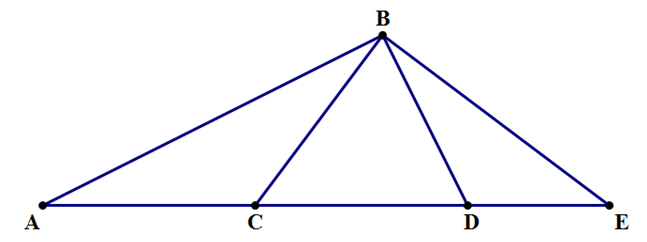
 

3)  In the diagram above, ∠A = ∠ABC, ∠CBD = ∠BDC, and ∠CBE =90°.  If AE = 16 and DE = 4, what is the length of BE?

(A) 7

(B) 8

(C) 9

(D) 10

(E) 11


Practice Problem Solutions

1) This involves a relatively sophisticated trick known as “multiplying by the conjugate.”  When we have an expression of the form a+sqrt(b), the “conjugate” of this is a-sqrt(b).  When we multiply a radical expression by its conjugate, we employ the difference of two squares.  For example:

1/{2-sqrt{3}} = (1/{2 - sqrt{3}}) * {(2 + sqrt{3})/(2 + sqrt{3})} = (2 + sqrt{3})/(2^2 - (sqrt{3})^2) = (2 + sqrt{3})/(4 - 3) = (2 + sqrt{3})/1 = 2 + sqrt{3}

This is answer B.  BTW, the trick of multiplying by the conjugate is at the very outside edge of what you might be expected to do the hardest GMAT math problems.


2) The prompt of this DS problem is straightforward.

Statement #1 tells us a = 4, but we have no idea of b, so, by itself, this is not sufficient for finding the sum.

Statement #2 gives us a value for an algebraic expression that lends itself nicely to simplification.


7 = {b^2 - a^2}/{b - a} = {(b-a)(b+a)}/{b-a} = a + b


Thus, the sum is 7.  Statement #2, by itself is sufficient.  Answer = B.


3) This is a tricky one.  Remember, it’s a diagram drawn to scale, so if all else fails, you can estimate (see this post).  But, let’s solve this with math.  The fact that ∠A = ∠ABC tells us triangle ABC is isosceles, with AC = BC.  The fact that ∠CBD = ∠BDC tells us triangle BCD is isosceles, with BC = CD.  The fact that ∠CBE = 90° means that (BC)2 + (BE)2 = (CE)2.  This means


(BE)^2 = (CE)^2 - (BC)^2

{} = (CE + BC)(CE - BC)

{} = (CE + AC)(CE - CD) (substitutions from the two isosceles triangles)

{} = (AE)(DE)

{} = (16)(4) = 64 right BE = 8


Answer = B


Here’s a further practice question.

http://gmat.magoosh.com/questions/118



About the Author

Mike McGarry is a Content Developer for Magoosh with over 20 years of teaching experience and a BS in Physics and an MA in Religion, both from Harvard. He enjoys hitting foosballs into orbit, and despite having no obvious cranial deficiency, he insists on rooting for the NY Mets.

8 Responses to GMAT Quant: Difference of Two Squares

  1. domenico June 5, 2012 at 4:13 pm #

    No. :)

    Only things I can say is thanks for the stunning explanation .

    Best Regards

    • Mike June 5, 2012 at 4:59 pm #

      Thank you for your kind words. Best of luck to you.
      Mike :)

  2. domenico June 4, 2012 at 6:42 pm #

    First question in 30 seconds

    Second in 20 seconds : 1) we do not know nothing about b; 2 (b-a)(b+a)/(b-a) = 7 you can cross off (b-a) both numerator and denominator b+a = 7

    Third question…………lost :(

    Thanks Mike

    • Mike June 5, 2012 at 12:22 pm #

      That third one is very tricky. There are a lot of piece to keep straight. We are given angle CBE is a right angle, so triangle CBE is a right triangle, so the Pythagorean Theorem applies —- (BC)^2 + (BE)^2 = (CE)^2, or (BE)^2 = (CE)^2 – (BC)^2. The trouble is, we don’t have either of those at the moment. BUT, it is a difference of two squares, so we could get very lucky with other information in the problem.
      There are two isosceles triangles in the diagram: we know this from the angles. The Isosceles Triangle Theorem tells us that, in Triangle ACB, AC = BC; and in triangle BCD, BC = CD — again, that is a direct consequence of the pairs of angles that are equal as well as of the Isosceles Triangle Theorem. The upshot of those is AC = BC = CD. Remember those: we will need those equations for substitutions in a moment.
      Well, now, we notice:
      16 = AE = CE + AC = CE + BC (substituting BC for AC)
      4 = DE = CE – CD = CE – BC (substituting BC for CD)
      We want to calculate (CE)^2 – (BC)^2, and by a series of fortuitous mathematical connections, we have a numerical value for both CE + BC and CE – BC, so we are home free!
      (BE)^2 = (CE)^2 – (BC)^2 = (CE + BC)(CE – BC) = 16*4 = 64
      BE = 8
      Does all this make sense? Let me know if you have any further questions.
      Mike :)

  3. AbhiJ May 31, 2012 at 4:53 am #

    In problem 2, if a = b = 3.5, then the equation in (2) breaks down as a =! b for a+b = 7.

    • Mike June 1, 2012 at 7:55 am #

      First of all, a & b cannot be equal, because that would create a 0/0 error in statement #2. There is no reason they have to be equal. In fact, since we know a = 4 from Statement #1, we know b would have to equal 3, so a & b are not equal. Does that make sense? Mike :)

      • AbhiJ June 6, 2012 at 5:39 am #

        The answer for question 2 is B.

        Hence we are not using any information from statement 1, that is a = 4.

        Considering Statement 2 alone, there is no reason as to why we cannot have a = b. In DS are we not supposed to check for all possibilities ?

        Considering this, the answer would be C(Using Statement 1 and Statement 2).

        • Mike June 6, 2012 at 10:09 am #

          AbhiJ —
          You are correct, the answer to #2 is B, which means considering B by itself should be sufficient to answer the question.
          You say: “Considering Statement 2 alone, there is no reason as to why we cannot have a = b”, but this is mathematically incorrect. In statement #2, we are told (b^2 – a^2)/(b-a) = 7. Insofar as the algebraic expression (b^2 – a^2)/(b-a) equals any number at all, we know it is well-defined. If a equaled b, then the expression (b^2 – a^2)/(b-a) would be indeterminate (0/0), which means (in the absence of taking a limit), it could not be equal to *any* numerical value. The fact that the expression equals a numerical value (i.e. that it is “determined” to equal a particular number) itself precludes the possibility of indeterminancy, which in turn precludes any possibility that a = b. Therefore, there are rigorous mathematical reasons why we know, from Statement #2 alone, that a absolutely cannot equal b.
          “In DS are we not supposed to check for all possibilities?” Yes, all possibilities that are consistent with the statement itself and consistent with the ineluctable mathematical underpinning of the problem. In this particular instance, that means a = b is not a valid possibility to consider.
          Does all this make sense?
          Mike :)


Magoosh blog comment policy: To create the best experience for our readers, we will approve and respond to comments that are relevant to the article, general enough to be helpful to other students, concise, and written with correct grammar and spelling! :) If your comment was not approved, it likely did not adhere to these guidelines. If you are a Premium Magoosh customer and would like more personalized service, you can send us any questions you have through the Help tab in the product and we will always respond within 24 hours. Thanks!

Leave a Reply